You spot a navy wool blazer on the rack at your local consignment shop. The shoulders look right, the lapels are a flattering width, and the price tag says $38. You imagine it with dark jeans and a white tee, or over a slip dress for a fall dinner. Then you notice the lining is torn at the armpit, the front buttons are mismatched, and the sleeve heads are puckered. A tailor could fix all of it — but you’re about to spend $60 on alterations for a $38 jacket that may not survive the season. This is the moment the checklist matters.
The blazer is one of the highest-stakes secondhand purchases you can make. Unlike a sweater or a pair of jeans, it has structure: canvas, shoulder pads, lining, and a collar that needs to sit flat. Alterations on a blazer are also the most expensive in the tailor’s book. A sleeve shortening runs $25–$45. Taking in the waist costs $30–$60. Replacing a lining can exceed $100. Before you authorize any of that, you need to know whether the jacket is worth the investment — and whether the alterations are even possible.
This checklist walks you through the questions to ask, in the order you should ask them, while you’re still in the fitting room. Bring it on your phone. Ask a friend to read the questions aloud if you’re shopping together.
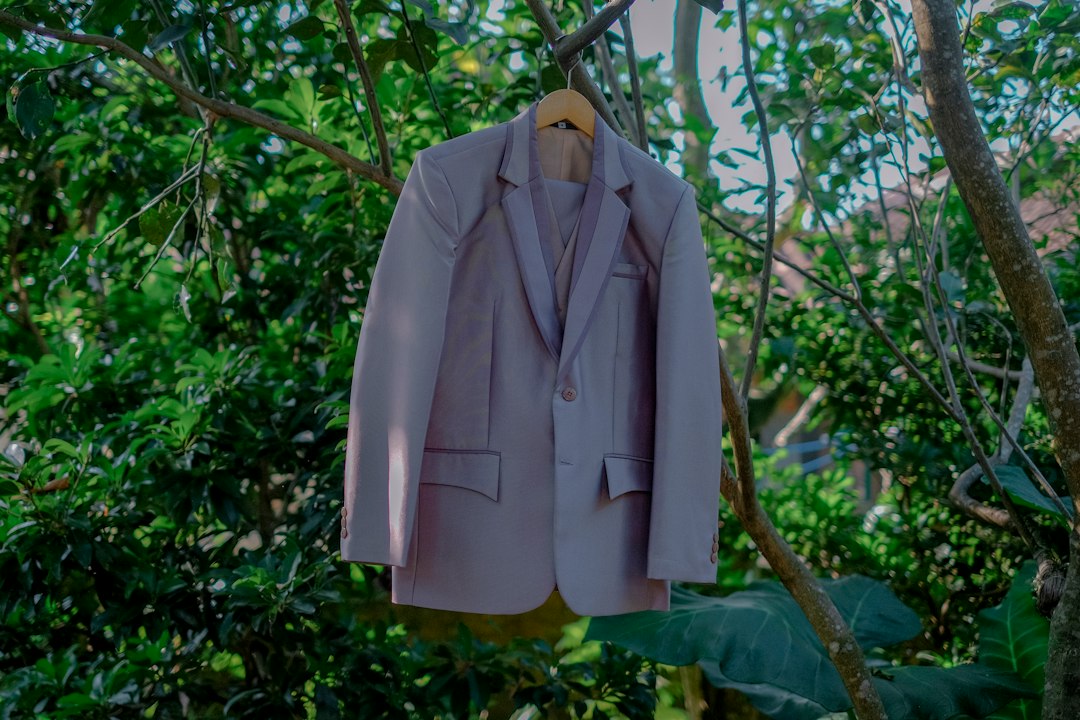 Photo by agust moto on Unsplash
Question 1: Is the Shoulder Actually Your Shoulder?
The single most important question in blazer shopping is also the one most shoppers skip. Shoulders are the hardest part of a jacket to alter. A tailor can take in a waist, shorten a sleeve, and even adjust a collar, but rebuilding a shoulder line requires reconstructing the entire jacket — and most tailors will refuse the job or charge more than the jacket is worth.
Here’s what to check. Put the blazer on over a light shirt or tee. Stand in front of a mirror and look at the shoulder seam. It should sit at the edge of your natural shoulder bone, no more than half an inch past it. If the seam droops down your arm, the jacket is too big and the shoulder will need rebuilding. If the seam sits on top of your shoulder with your arm bulging out, the jacket is too small.
Then check the shoulder pad. Press the pad gently between your thumb and fingers. A well-made blazer has a pad that feels firm but not rigid — it should hold its shape when you move, not collapse or crinkle. If you can feel a hard plastic edge or the pad has shifted out of position, that’s a red flag. Pads can be replaced, but it’s a $50–$80 job at most tailors.
Finally, raise both arms above your head. The jacket should lift slightly but not ride up to your ears. If the whole jacket hikes up, the armholes are too low or the shoulders are too wide. Neither is fixable at a reasonable cost.
The shoulder test in three seconds
If the shoulder seam doesn’t sit within half an inch of your natural shoulder bone, put the jacket back. This is the one non-negotiable. Everything else on this list can be tailored. The shoulder cannot.
Question 2: What’s Happening Inside the Jacket?
Turn the blazer inside out. This is where the real story of quality lives, and it’s the step most shoppers skip because it feels fussy. It isn’t. The inside of a blazer tells you how it was made, how it will wear, and whether it’s worth altering.
Start with the lining. A good lining is made of breathable fabric — cupro, viscose, or a silk blend — and it’s attached with generous seam allowances so it can move with the jacket. Check the armpits first, since that’s where linings fail. Look for tears, stains, and shattering (the fabric crumbling at the fold). A small tear at the underarm seam can be repaired for $15–$25. A shattered lining across the back means the jacket is near the end of its life.
Next, find the seams. Turn the jacket inside out and look at the side seams and the shoulder seams. Are they finished with a serger (a clean, overlocked edge) or are they raw and fraying? Are there generous seam allowances — at least half an inch — or are the seams trimmed so close to the stitch line that there’s no room to let the jacket out? A well-made blazer has seam allowances that allow for minor size adjustments. A cheaply made one is trimmed to the edge, which means no alterations are possible.
Then look for the canvas. A fully canvassed blazer has a layer of horsehair or wool canvas floating between the outer fabric and the lining. You can feel it by pinching the front of the jacket between your thumb and fingers — it should feel like there’s a third layer in there, not just two flat pieces of fabric fused together. Fused blazers (where the interfacing is glued to the fabric) are cheaper to make but prone to bubbling and delamination over time, especially after dry cleaning. If you’re buying secondhand, a fused blazer that has already been dry-cleaned several times may be on borrowed time.
The lining and seam check
Run your hand along the inside of the jacket. Feel for loose threads, puckered seams, and any place where the lining is pulling away from the shell. A blazer with a clean, generous lining and intact seams is a candidate for alterations. One with a shattered lining and trimmed seams is not.
Question 3: Does the Fabric Have a Future?
Fabric quality is where secondhand shopping gets interesting, because you’re seeing the fabric after it’s been worn. A blazer that has been worn and cared for will show you exactly how the fabric behaves over time — and that’s more information than any new jacket tag can give you.
Start with the fiber content. Check the label if it’s still attached, but don’t rely on it alone. Wool, wool blends, linen, and cotton are the most alteration-friendly fibers. Polyester and acrylic blends are cheaper and more wrinkle-resistant, but they pill, hold odor, and don’t breathe. A wool blazer that’s been worn for a decade may still have years left. A polyester blazer that’s been worn for two years may already be showing shine at the elbows and seat.
Then look at the surface. Hold the jacket up to the light and check for shine, especially at the elbows, the seat, and the front hem. Shine is a sign of fiber damage — the fabric has been pressed or worn to the point where the fibers are flattened and reflecting light. It cannot be reversed. Check for pilling under the arms and along the cuffs. Some pilling can be shaved off with a fabric comb, but heavy pilling means the fibers are short and the fabric is breaking down.
Check the elbows and the seat for thin spots. Hold the fabric up to a window or a light. If you can see light through the elbows or the seat, the fabric is worn thin and will likely tear soon. That’s not a candidate for alterations — it’s a candidate for the rag bag.
Finally, check the color. Secondhand blazers often have fading at the shoulders and the back from sun exposure. A little fading is character. Heavy fading means the fabric has been degraded by UV light and may be weaker than it looks. Hold the jacket next to a piece of the same color fabric if you can, or ask the shop if they have a matching piece. If the fading is significant, the jacket will always look slightly tired, no matter how well it’s tailored.
For a deeper look at how natural fibers behave over time, our guide to linen, hemp, and cotton for hot-weather workwear breaks down breathability and durability in detail. The same principles apply to blazer fabrics: natural fibers age better and tailor more gracefully than synthetic blends.
Question 4: Can the Buttons and Details Be Saved?
Buttons are the easiest thing to replace on a blazer, but they’re also a useful signal of overall quality. A well-made blazer has buttons that are securely attached with a shank — a small thread neck that lifts the button away from the fabric so it can be buttoned without pulling. Check the back of each button. If the thread is loose or the button is attached flat against the fabric, it will pull and eventually tear the buttonhole.
Count the buttons. A single-breasted blazer should have two or three front buttons. A double-breasted blazer should have four or six. If buttons are missing, that’s not a dealbreaker — you can replace them — but it’s a negotiation point on price. A set of matching horn or corozo buttons costs $8–$20, and a tailor will charge $15–$25 to sew them on.
Check the buttonholes. They should be cleanly finished, not frayed or stretched. A frayed buttonhole is a sign the jacket has been worn hard and may need to be reworked, which is a $10–$20 job per hole. Check the pockets, too. Are they still stitched shut (a sign the jacket was never worn) or have they been opened and used? Open pockets are fine, but check the pocket bags for holes and stains.
Finally, check the vents. A blazer with a single back vent is more forgiving on the hips; a double vent is more flattering on curvier figures. Check that the vents lie flat and aren’t puckered or torn. A torn vent can be repaired, but it’s a $20–$40 job.
The button and detail check
If the buttons are mismatched and the buttonholes are frayed, factor $40–$60 into your alteration budget. If the vents are torn and the pockets are stained, walk away. The jacket is telling you it’s been worn hard, and the repairs will exceed the value.
Question 5: What Will the Alterations Actually Cost?
This is the question that separates a good secondhand buy from an expensive mistake. Before you pay for the jacket, estimate the alterations. A blazer that fits perfectly needs none. A blazer that needs a waist take-in, a sleeve shortening, and a button replacement needs $80–$120 of work. If the jacket costs $40 and the alterations cost $100, you’re at $140 for a secondhand blazer — which may still be a good deal if the jacket is well-made, but it’s no longer a bargain.
Here’s a rough alteration cost guide for blazers, based on typical tailor pricing in the US:
| Alteration | Typical cost | When it’s worth it |
|---|---|---|
| Sleeve shortening | $25–$45 | Almost always, if the sleeves are more than 1 inch too long |
| Waist take-in | $30–$60 | Worth it on a well-made jacket with intact seams |
| Button replacement (set) | $15–$25 | Worth it if the jacket is otherwise sound |
| Lining repair (underarm) | $15–$25 | Worth it if the tear is small and the lining is otherwise intact |
| Lining replacement | $100–$150 | Rarely worth it on a secondhand jacket under $150 |
| Shoulder adjustment | $80–$150+ | Almost never worth it — most tailors won’t do it |
| Vent repair | $20–$40 | Worth it on a jacket you love; otherwise, skip |
The rule of thumb: if the alterations cost more than the jacket, and the jacket isn’t a known quality brand or a perfect fit in the shoulders, walk away. There will be another blazer.
If you’re shopping for a specific occasion, like a fall wedding, our guide to building a fall wedding guest outfit from secondhand pieces shows how a single well-tailored blazer can anchor multiple looks — which makes the alteration investment easier to justify.
Question 6: Is the Brand Worth the Alteration Risk?
Brand isn’t everything, but it’s a useful signal when you’re deciding whether to invest in alterations. A well-made blazer from a known quality brand — think Theory, Vince, Eileen Fisher, or a classic menswear-inspired label — is more likely to have the seam allowances, lining quality, and fabric integrity that make alterations worthwhile. A fast-fashion blazer from a brand that changes its production every season is more likely to be fused, trimmed, and near the end of its life.
That said, don’t dismiss an unbranded or vintage blazer just because you don’t recognize the label. Some of the best secondhand blazers are from defunct menswear labels or small European factories that made excellent garments. Check the inside label for fiber content and country of origin. A blazer made in Italy, Portugal, or the US in the 1980s or 1990s is often better made than a contemporary fast-fashion piece.
If you’re shopping online, ask the seller for photos of the inside label, the lining, and the seams. A good seller will provide them. If they won’t, that’s a signal.
For a sense of how brand quality plays out in practice, our comparison of Quince, Everlane, and Uniqlo for affordable work wardrobes breaks down which brands actually hold up over time — useful context when you’re deciding whether a secondhand blazer from one of these labels is worth the alteration investment.
 Photo by Laura Chouette on Unsplash
The Shortlist Criteria That Matter
Before you hand over your card, run through this shortlist. If a blazer passes all six, it’s worth the alterations. If it fails any of the first three, put it back.
-
The shoulder seam sits within half an inch of your natural shoulder bone. This is non-negotiable. If it doesn’t, the jacket is not your size, and no alteration will fix it at a reasonable cost.
-
The lining is intact at the armpits and the seams have generous allowances. A small underarm tear is fixable. A shattered lining or trimmed seams are not.
-
The fabric is sound at the elbows and seat. Hold it up to the light. If you can see through it, it’s worn out. If it’s shiny or heavily pilled, it’s breaking down.
-
The buttons and buttonholes are in usable condition. Mismatched buttons are fine. Frayed buttonholes and torn vents are negotiation points, not dealbreakers — but factor the repair cost into your budget.
-
The total cost — jacket plus alterations — is less than what you’d pay for a comparable new jacket. A $40 blazer with $100 of alterations is a $140 blazer. That’s fine if it’s well-made and fits perfectly in the shoulders. It’s not fine if it’s a fused fast-fashion piece.
-
The brand or construction signals long-term quality. Check the label, the seams, and the canvas. A fully canvassed blazer from a quality label is worth altering. A fused blazer from a fast-fashion brand is not.
What to do next
Take this checklist to your next consignment or thrift appointment. Before you try anything on, ask the shop whether they allow returns on altered items — most don’t, so you need to be confident before you buy. If you’re shopping online, ask for photos of the lining, the seams, and the label before you commit.
And if you’re building a blazer collection rather than buying a single piece, start with a navy or charcoal wool blazer that passes all six criteria. It will anchor more outfits than any other jacket in your closet — and it will be worth every dollar you spend on alterations. For more on how to care for the wool pieces you already own, our guide to caring for secondhand wool trousers covers the pressing, moth, and lining care that keeps tailored wool garments in rotation for years.