The email lands on a Tuesday: Thanksgiving at your partner’s aunt’s house this year, a two-hour drive each way, and dinner served at 2 p.m. sharp. You open your closet and see the usual cast of characters—the jeans you live in, the one dress that feels too summery, a blazer that’s seen better days. Nothing reads “meeting the extended family” and “eating three plates of food” and “sitting in a car for four hours” at the same time.
So you do what you always do under deadline: you open a browser tab. And there it is—a $148 “holiday-ready” knit dress in a color called something like Harvest Fig, one-day shipping if you order in the next six hours. It would arrive Thursday morning. It would also be the fourth thing you’ve bought this fall to solve a problem you already owned clothes for.
Here’s the reframe that actually works: Thanksgiving isn’t one outfit problem. It’s three. Hosting, visiting, and traveling each ask something different of your clothes—different heat, different sitting, different shoes-off-or-shoes-on calculus—and once you separate them, you can build a small set of repeatable formulas from pieces you already own. Below are three secondhand-first outfit formulas, the decision rules behind them, and a packing plan that treats the whole weekend as one system instead of three panic purchases.
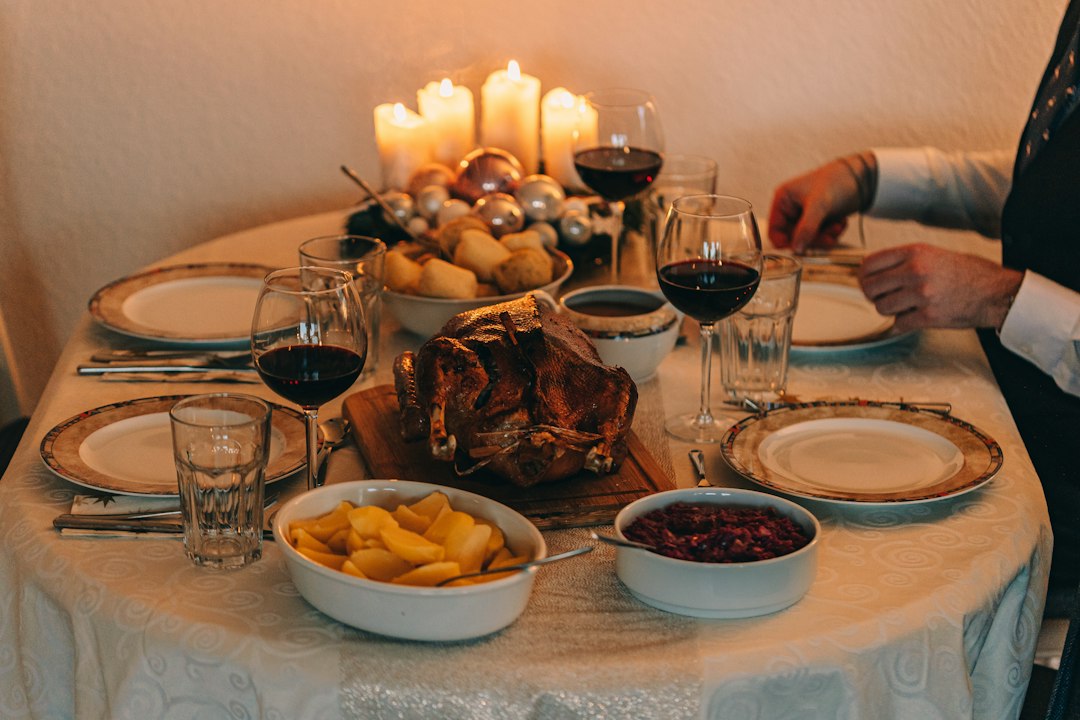 Photo by Noah Samuel Franz on Unsplash
The Three Contexts, and Why They Change What You Wear
Before the outfits, the logic. Thanksgiving dressing fails when you treat it as a single occasion, because the physical demands are contradictory.
Hosting means you’re in your own kitchen for four hours before anyone arrives, then on your feet refilling glasses and carving things. You need an outfit that survives oven heat, splatters, and bending over a dishwasher—but still looks intentional when the doorbell rings. The enemy here is anything dry-clean-only, anything that shows grease, and anything tight enough to make you dread the post-meal bloat.
Visiting means you’re a guest in someone’s home, likely sitting for long stretches, possibly on the floor with a cousin’s toddler, possibly on a couch that’s seen a decade of holidays. You need softness, forgiving waistbands, and layers you can shed when the radiator wins. The enemy here is stiff tailoring and anything that requires a special bra.
Traveling means hours in a car, train, or plane, then arriving somewhere that may be twenty degrees colder or warmer than where you started. You need stretch, a layer you can remove without exposing anything, and shoes that work for both the journey and the dinner table. The enemy here is anything that creases into a map of your seatbelt.
The pieces that serve all three contexts share three traits: natural fibers that breathe and don’t hold odor, a relaxed but deliberate silhouette, and a color story that plays well with gravy, red wine, and candlelight. That’s the filter. Now the formulas.
Formula 1: Hosting — The Apron-Proof Knit and Wide-Leg Uniform
The core idea: dress like you mean to be in the kitchen, but in a way that photographs well when you finally sit down.
The pieces
- A fine-gauge knit top or sweater in a dark, forgiving color—charcoal, deep olive, oxblood, navy. Secondhand cashmere or merino is ideal here; a good thrifted sweater costs a fraction of new and the fiber quality is often better than contemporary fast knitwear. If you’re unsure what to look for, our secondhand knitwear shopping checklist covers the fiber, feel, and fit inspection in detail.
- Wide-leg trousers or a midi skirt in a fluid fabric—wool blends, heavy cotton twill, or a substantial jersey. Wide legs give you room to move and to eat, and they read more “host” than “leggings.”
- An apron you actually like. This is the unsung hero of hosting outfits. A linen cross-back apron in a dark color protects the knit and looks like a deliberate styling choice rather than a defense mechanism.
- Flat or low shoes you can stand in for four hours. Secondhand leather loafers or clogs. If you’re buying boots for the season, our secondhand boot inspection guide is the checklist to run before you pay for resoling.
The decision rules
- No exposed skin above the wrist or below the knee. Ovens, splatters, and hot pans make this practical, and it happens to look polished.
- One dark piece, one lighter piece. All-dark reads somber at a holiday table; all-light is a stain magnet. Split the difference.
- Nothing that needs special undergarments. You will be bending, reaching, and lifting a turkey. Dress accordingly.
- Sleeves you can push up. A three-quarter or easily pushed sleeve keeps you cool at the stove and looks intentional at the table.
A concrete combination
A thrifted charcoal merino crewneck (slightly oversized, sleeves pushed to the elbow), a secondhand pair of wide-leg wool-blend trousers in a warm taupe, a dark linen apron, and black leather loafers. Add a single piece of jewelry—a gold chain or a pair of small hoops—and you’re done. The whole outfit is four pieces, three of which you likely own. If you want to make the knit last for years, the off-season knitwear storage playbook is worth bookmarking for January.
Formula 2: Visiting — The Soft Layer and Forgiveness Waistband
Visiting is the formula where comfort and polish have to shake hands. You’re a guest, so you want to look like you made an effort; you’re also going to be sitting for hours, possibly on the floor, possibly holding a plate on your lap.
The pieces
- A soft, relaxed dress or a knit-and-skirt pairing in a fabric with some give. Jersey, ponte, fine-gauge knit, or a fluid wool blend. Avoid stiff poplin and anything with a defined waistband that digs.
- A layer you can remove—a cardigan, a blazer, a quilted vest. The host’s thermostat is unknowable; assume you’ll need to shed and re-add.
- A forgiving waistband. Elastic-back trousers, a wrap skirt, a dress with a tie waist. This is not the day for the jeans that require a lie-down to button.
- Shoes you can slip off at the door without embarrassment. Clean socks matter here; treat them as part of the outfit.
The decision rules
- Dress one notch above the room, not two. You want to look like you tried, not like you’re auditioning. A knit dress plus a cardigan is the sweet spot.
- The layer should work on its own. If you take off the cardigan, the base outfit should still look complete—not like a slip.
- Choose a color that flatters candlelight. Warm tones—rust, camel, deep green, burgundy—photograph beautifully at a dinner table and hide the occasional drip.
- Test the sit. Before you commit, sit on the floor, cross your legs, and stand back up. If anything rides up, gaps, or requires adjustment, swap it.
A concrete combination
A secondhand fine-gauge knit dress in deep green (or a knit skirt and matching top), a camel cardigan worn open, and low leather boots or loafers. Add a silk scarf at the neck if you want a little ceremony—secondhand silk is plentiful and cheap, and our secondhand silk care playbook explains how to wash and store it so it survives the gravy. If you’re building this from scratch, the secondhand silk versus new silk comparison is the place to start.
Formula 3: Traveling — The Car-to-Table Layer System
Traveling is where most Thanksgiving outfits collapse, because people dress for the destination and forget the journey. The fix is to build the outfit as a system of layers, so the same base works in a cold car, a warm kitchen, and a chilly dining room.
The pieces
- A base layer with stretch—a fine knit top, a jersey turtleneck, or a long-sleeve tee in a natural fiber.
- A mid-layer that doesn’t crease—a quilted vest, a structured cardigan, a ponte blazer. Avoid linen and lightweight cotton, which will look like you slept in them.
- A bottom with recovery—ponte trousers, dark straight-leg jeans with a bit of stretch, or a knit midi skirt. The test: sit in them for an hour, stand up, and check the knees.
- A shoe that works for driving and dining—a low boot, a loafer, a clean sneaker. Nothing you can’t operate a pedal in.
- A scarf or wrap that doubles as a blanket in the car and a layer at the table.
The decision rules
- Dress in layers you can remove in public without revealing anything. The car will be hot; the house will be cold; the dining room will be both.
- One bag, one outfit change maximum. If you’re staying overnight, pack a second base layer, not a second outfit. The cold-weather city break capsule formula applies the same logic to a longer trip.
- Wrinkle-resistant over wrinkle-prone. Knits, ponte, and wool blends travel; crisp cotton and linen don’t.
- Wear your bulkiest layer on the journey. It saves packing space and keeps you warm in a cold car.
A concrete combination
A fine-gauge merino turtleneck in cream, dark ponte trousers, a quilted olive vest, and black leather boots. A large scarf in a warm plaid doubles as a car blanket. If you’re driving, swap the boots for loafers and keep the boots in the trunk for arrival.
The Weekend as One System: A Packing Table
If you’re doing more than one of these—say, hosting Thursday and traveling to family Friday—the smart move is to build a single three-outfit system where pieces overlap. Here’s how the formulas compare on piece count and packing slots.
| Formula | Core pieces | Layers | Shoes | Packing slots (overnight) |
|---|---|---|---|---|
| Hosting | Knit top, wide-leg trousers | Apron | Loafers | 3 (apron stays home if visiting) |
| Visiting | Knit dress or knit set | Cardigan | Low boots | 3 |
| Traveling | Knit base, ponte trousers | Quilted vest, scarf | Boots or loafers | 4 |
| Shared overlap | One dark knit, one neutral bottom | One cardigan works for all three | One pair of loafers | 7–8 total for the weekend |
The overlap is the point. A single dark fine-gauge knit and a single pair of neutral wide-leg or ponte trousers can anchor all three formulas; the cardigan moves between visiting and traveling; the loafers work for hosting and travel. That’s a weekend wardrobe of seven or eight pieces, most of which you already own.
 Photo by Virginia Simionato on Unsplash
What to Do If You Genuinely Need One Piece
Sometimes the formula reveals a real gap—you don’t own a single forgiving knit dress, or your only trousers are jeans. In that case, buy one piece, secondhand, and buy it to fill a slot rather than to fill a mood.
The highest-leverage single purchase for this weekend is almost always a fine-gauge knit in a dark neutral—charcoal, navy, deep olive. It works as the hosting top, the visiting base, and the traveling layer, and it’s the piece most likely to be found secondhand in excellent condition because people underestimate how much they’ll wear it. Look for merino or cashmere with a tight gauge and no pilling under the arms; our knitwear shopping checklist walks through the inspection. If you’d rather buy new, a mid-weight merino crewneck from a brand like [AFFILIATE_LINK_EVERLANE] or a secondhand cashmere crew from [AFFILIATE_LINK_UNIQLO] via a resale platform will do the job without a holiday markup.
The second-highest-leverage piece is a forgiving bottom—wide-leg wool-blend trousers or a ponte midi skirt. Both are common secondhand finds and both solve the sitting-and-eating problem that jeans don’t.
What you don’t need: a new “holiday” dress, a novelty sweater, or anything in a color you’ll wear once. The test for any Thanksgiving purchase is whether you’d wear it on a random Tuesday in February. If the answer is no, it’s a costume, not a wardrobe piece.
Repeatable Outfits, Not One-Off Looks
The reason the $148 Harvest Fig dress is tempting is that it promises to solve a single day. The reason it usually disappoints is that it solves only that day—and then hangs in the closet until next November, a one-off look with a one-off cost per wear.
The three formulas above are built to do the opposite. The hosting uniform is the same outfit you’d wear to cook for friends on a Sunday. The visiting formula is the same outfit you’d wear to a family birthday. The traveling system is the same outfit you’d wear on any cold-weather road trip. Thanksgiving is the occasion that tests them, not the occasion that justifies them.
So the next step isn’t a shopping trip. It’s a fifteen-minute closet audit before the weekend: pull the dark knit, the forgiving bottom, the layer you can remove, and the shoes you can stand in. Lay them out together. If one slot is genuinely empty, buy one secondhand piece to fill it—and only one. Then pack the system, not the outfit, and let the weekend be about the people at the table rather than the thing you’re wearing to it.